

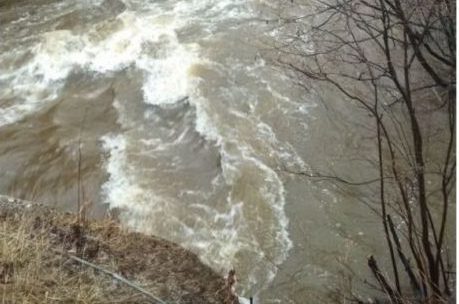

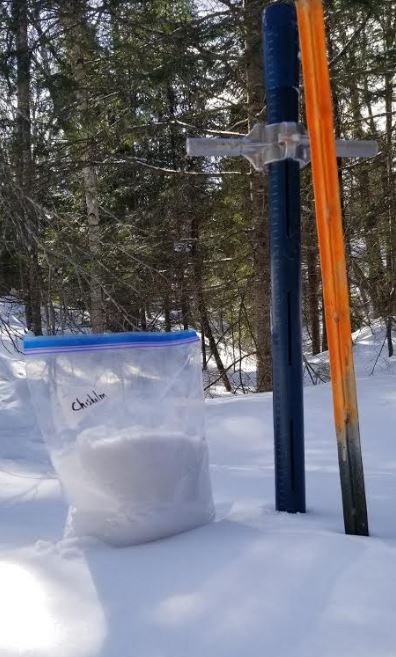
Snow depth and water equivalence remain above the long-term average for this time of year and are more than double last year’s measurements according to the North Bay-Mattawa Conservation Authority. The NBMCA measures the snow pack as part of its Flood Forecasting Program.
“There has been little change in the snow pack depth since the last survey two weeks ago,” said Joel Harrison, NBMCA’s Water Resource Scientist at the beginning of March. “However, the snow water equivalence has increased as the snow has become more compact and less fluffy.”
The snow depth average at the three sites is 85 centimetres (167 per cent of the long-term average for this time of year), up just 0.2 cm since the last snow survey readings. Meanwhile, the water equivalence of the snow pack is up 52 millimetres to 200.3 mm (177 per cent of the long-term average).
According to Canada.ca’s website entry on “Causes of flooding”:
During the Canadian winter, most of the precipitation is simply stored as snow or ice on the ground. During the spring melt, huge quantities of water are released, which explains our heavy spring runoff and flooding. This is called freshet.
Snowmelt runoff floods are the most common type of flooding in Canada. These floods generally occur in the spring but will also occur during sudden winter thaws. Heavy runoff results from the rapid melting of the snow under the combined effect of sunlight, winds, and warmer temperatures. When the ground is frozen, the water produced by the melting snow is unable to penetrate and runs off over the ground surface into streams and lakes. The amount of surface runoff is usually within the capacity of the channel to drain off without flooding. However, if there is an above-average snow depth, a sudden thaw, or both, then the potential for high volumes of runoff and subsequent flooding increases. The situation can become of even greater concern if the rising snowmelt runoff is compounded by runoff from heavy rainfall. The later the thaw, the more likely this situation will prevail. Since the climatic factors influencing the rate of snowmelt are often widespread, snowmelt runoff flooding conditions can exist over vast areas.
The long-term averages reflect measurements taken by NBMCA since it began measuring snow depth and water equivalence in 1987 as part of its Flood Forecasting Program.
NBMCA now measures in three locations including the North Bay Golf and Country Club (Chippewa Creek watershed), the Corbeil Conservation Area (LaVase River watershed) and Shirley Skinner Conservation Area (Kaibuskong River Watershed).